News
Eliminating Risk: The Safety Advantages of Using Probes and Drones Over Confined Space Entry
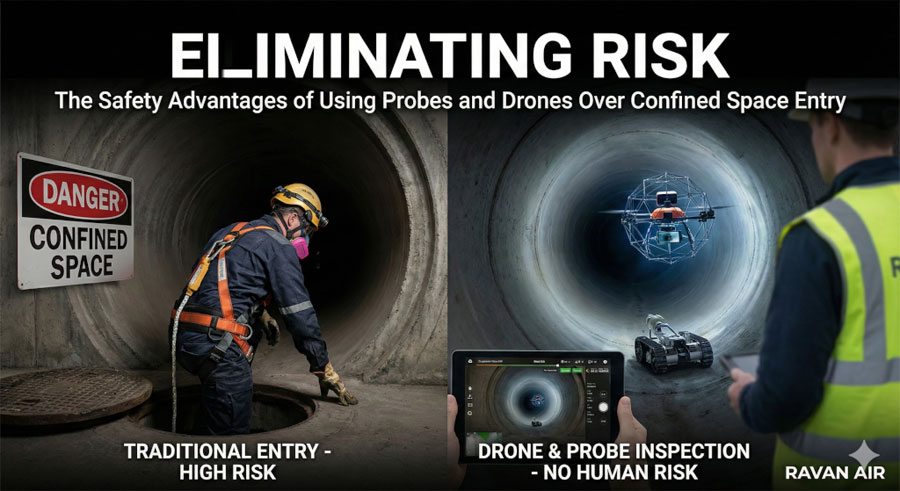
In the inspection industry, the word “danger” isn’t a theory; it’s a daily reality for the men and women who maintain our nation’s infrastructure. However in 2026, the way we handle industrial inspections has changed for the better. We no longer use the old ways of sending people into dark, tight, and toxic spaces just to see if a pipe is cracked.
By focusing on eliminating risk, we have found a way to work smarter and keep our teams safe. This shift is not just about new gadgets; it is about a total change in how we think about safety. Using probes and drones is the most powerful way of eliminating risk and what was once a high-stakes gamble into a controlled, data-driven operation.
In this article, we are going to walk you through how RAVAN AIR is using this technology to change the game, protect lives, and get better results for our clients.
The High Stakes of Underground Piping
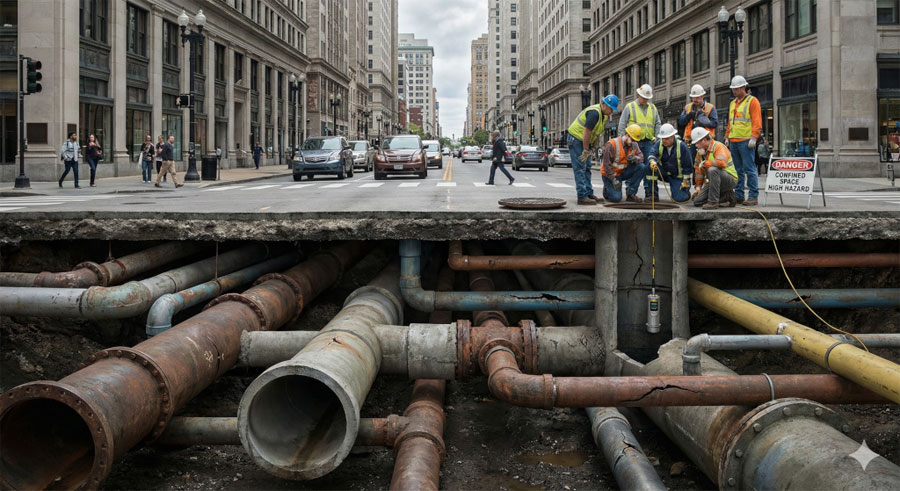
When you think of a city, you probably think of the buildings and the streets. But we think about the thousands of miles of pipes beneath your feet. These pipes carry water, waste, and chemicals. They are the veins and arteries of our world. To keep them working, we have to inspect them.
In the past, this meant a person had to go down there. This is what we call a confined space. It is a place that is not meant for people to stay in for long. It has limited ways to get in and out. For a long time, this was just “part of the job.” But it was a job that came with a heavy price. Every time a worker climbs into a manhole or a storage tank, they are facing threats you can’t always see. By using modern tools, we are finally eliminating risk at its source. We are making sure the only thing going into those dangerous holes is a machine that can be replaced, not a person who can’t.
The Critical Hazards of Confined Space Entry (CSE)
To understand why we are so focused on eliminating risk, you have to know what is waiting in those pipes. The first big danger is the air. Many underground spaces don’t have enough oxygen. You can’t see it or smell it, but if you do not have enough to breathe, you can pass out in seconds. Other times, there are toxic gases like hydrogen sulfide, which smells like rotten eggs at first but then kills your sense of smell before it kills you.
Then there is the risk of “engulfment.” This is a fancy word for getting buried or drowned. A pipe could suddenly fill with water, or a pile of grain in a silo could collapse. There are also physical dangers. You could fall, get stuck in a narrow spot, or get hit by moving parts. The most heartbreaking part is the “rescuer’s trap.” Statistics show that when a worker gets in trouble, their friends often jump in to save them without thinking. This often leads to more deaths. This is why eliminating risk by staying outside is the only way to be 100% safe.
Probes and Drones: The Technological Vanguard
When people talk about NASSCO Certification, they are usually talking about a family of three distinct programs. Each one focuses on a different part of the sewer system. To get a complete picture of an underground network, you need to understand all three.
Safety Advantages: Human Risk vs. Hardware Risk
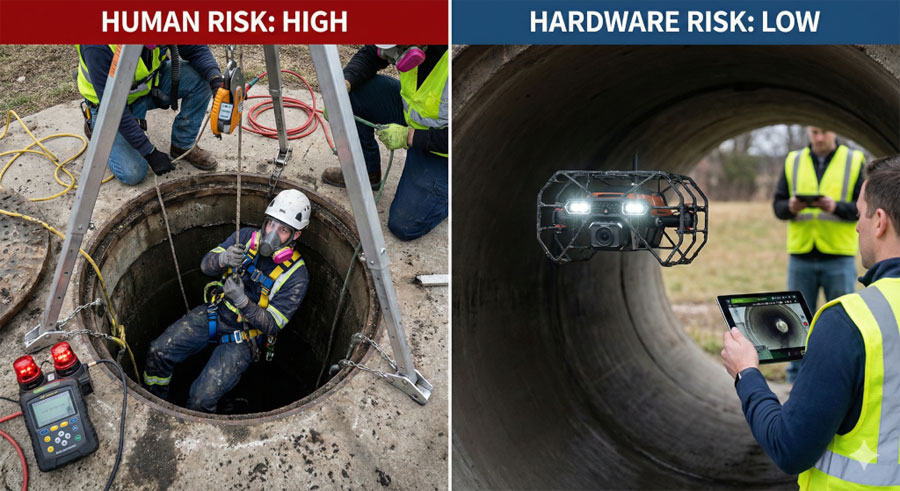
When we compare a human entry to a drone flight, the winner is clear. For a human to enter a permit-required space, you need a huge team. You need a person to go in, a person to watch from the outside, and a rescue team standing by. You have to spend hours testing the air and setting up blowers to move the air around. Even then, things can go wrong.
With a drone or a probe, most of that work goes away. The operator stays in the fresh air. If the drone crashes or the probe gets stuck, it is a bad day for our equipment, but nobody gets hurt. We call this “shifting the risk.” We would rather lose a piece of expensive hardware than a member of our team. This is the heart of eliminating risk. We also save a lot of time. What used to take a whole day can now be done in an hour. This means the pipes can get back to work faster, which saves money for our customers.
Technical Data Capture & Non-Destructive Testing (NDT)
One of the best things about these tools is the quality of the data they give us. A person in a dark pipe might miss a tiny crack because they are tired or cannot see it. However, this is not a problem for a drone. The drone captures high-definition video that we can look at over and over again. We also use LiDAR, which uses lasers to make a 3D map of the pipe. This lets us see if the pipe is starting to bend or change shape.
We also use something called Non-Destructive Testing, or NDT. Our probes can use sound waves to measure how thick a metal pipe is. This tells us if it is rusting away from the inside without us having to cut into it. This level of detail is a huge part of eliminating risk because it lets us fix problems before they become emergencies. When you have perfect data, you don’t have to guess. Guessing is dangerous. Knowledge is safety.
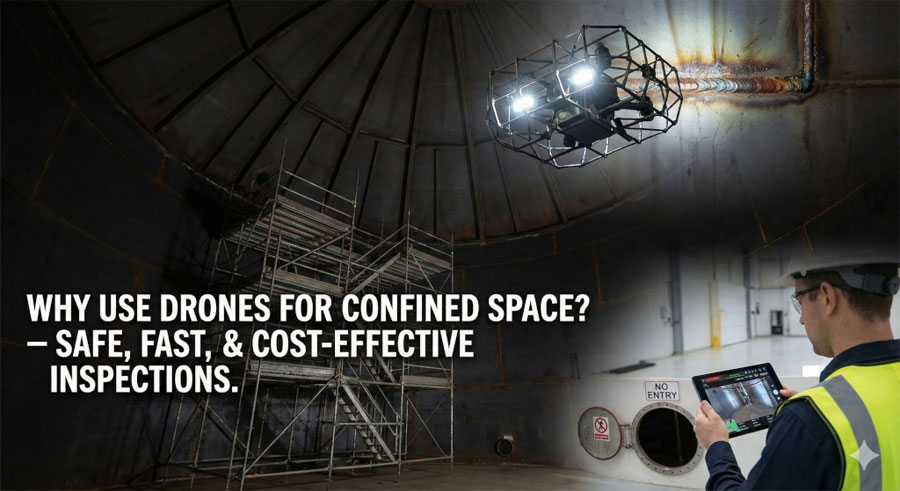
Why Use Drones for Confined Space?
This is a question we hear a lot from plant managers. The answer is simple: it is the most effective way of eliminating risk while getting the best results. Drones can reach the ceiling of a huge storage tank that would normally require building a massive tower of scaffolding. Scaffolding is expensive and dangerous to build. A drone can fly to the top in ten seconds.
Drones are also great because they can fly in “non-breathable” air. If a tank is full of nitrogen or carbon dioxide, a human would need a heavy air tank and a mask. A drone doesn’t need to breathe. It just needs a signal. By using these tools, we are eliminating risk of suffocation entirely. It also means we don’t have to empty and clean a tank as thoroughly before we look at it, which is another way of eliminating risk for the cleaning crews.
How Do Drones Improve Safety?
Drones improve safety by providing what we call “situational awareness.” Before anyone ever thinks about stepping foot into a work site, we send the drone in. It acts like a scout. It tells us if the walls are stable, if there is water on the floor, or if there are dangerous wires hanging down.
Sometimes, we find that a repair is so simple that we can do it from the outside using a long tool. Other times, we see that the space is too dangerous for anyone to ever enter. In those cases, the drone has literally saved a life by giving us the information we needed to stay out. Eliminating risk is about having the right information at the right time. A drone is the best information-gathering tool we have ever had.
Are Drones OSHA Compliant for Inspections?
Yes, they are. In fact, safety groups like OSHA are very happy when companies use drones. They have rules that say you should always try to find a way to do a job without entering a confined space if possible. Using a drone is the “preferred method” because it is so good at eliminating risk.
When we use a drone, we can often change the “permit” status of a job. If we can prove that no human needs to go in, we don’t have to follow the most dangerous and expensive rules. This doesn’t mean we get lazy; it means we have used technology to make the environment safer. Every safety officer I talk to agrees that eliminating risk through technology is the future of industrial work.
The 2026 Outlook: AI-Driven Hazard Detection
As we look at the current year of 2026, the technology is getting even smarter. We are now using Artificial Intelligence (AI) to help us. While the drone is flying, the AI is looking at the video in real-time. It can spot a rust spot or a tiny leak faster than a human can. It compares what it sees today to what it saw last year.
This helps us with eliminating risk by predicting the future. If the AI sees that a crack is growing, it tells us exactly when that pipe might fail. We can fix it during a planned break instead of waiting for it to explode. This is the ultimate way of eliminating risk because it prevents the accident from ever happening. We are moving from a world where we react to problems to a world where we stop them before they start.
Why You Should Pick RAVAN AIR
Eliminating risk isn’t just a goal; it’s a responsibility. At RAVAN AIR we are always thinking about how we can make this industry better. We are using data, innovation, and competence to lead the way.
The tools we have today, the Elios drones, the LiDAR sensors, and the AI software, are all focused on one thing: eliminating risk. We are keeping our workers safe, saving our clients money, and protecting the environment. This is the standard we set at RAVAN AIR.